Industrial Engineering (Wirtschaftsingenieurwesen) B.Sc. at TU Berlin: Student Guide
Table of Contents
Intro #
Greetings, dear friends!
Today I’m going to tell you about one interesting bachelor’s program - Wirtschaftsingenieurwesen (WiIng). In Russian I’d translate it as “engineer-economist”, and our uni translates it into English as “Industrial Engineering and Management” (no clue how they came up with that, but it sounds cooler).
First, a quick word about the Studiengang (degree program) itself! Imagine economics and some branch of engineering (in my case software engineering) got married and had a kid that got 70% of its genes from dad and 70% from mom. Yeah, I know, the math doesn’t add up, but sadly that’s how it is. They crammed everything they possibly could into our program… We take the same modules everyone else takes but get fewer LP (credit points) for them, or we take advanced modules without having done the basic courses. But it’s not all that bad! If you’ve got broad interests, love physics and math, have no hobbies and dream a lot about money, then you belong with us, my dear friend!
People ask me pretty often what you can actually do with this degree. I used to answer that you can do pretty much anything (my dad said so, I had no idea myself, I was dumb). But now I’m sure it’s actually true! I know a ton of people who studied/are studying WiIng, and they work everywhere: IT, audit, consulting, healthcare, agencies, the automotive industry, banks. I myself worked for two years at a marketing agency in the Business Intelligence and marketing departments. Now I work at a bank in the department that validates all the mathematical models (no idea how I ended up here, it’s fucking hard). As you can see, every path is open! Thanks to the mental abuse you’ll go through in WiIng, nothing will scare you and you’ll pull everything off!
I also have to mention how jealous I am of you. Uni isn’t just knowledge, it’s also cool new friends, buddies and adventures. But sadly I was just as “lucky” as Denis - my studies started during corona… So socially it was pretty rough at the beginning. But you got really lucky with this community! We’ve got a really active group here where people will always support you and give you solid advice. And there are lots of cool and interesting people here too 😉
So everybody drink a beer to Denis’s health! 🍻
General advice #
- Find motivated people for group projects or homework. You can always go solo, but why make life harder for yourself? At the start of the semester you scope out who sits in the front row and asks the prof a ton of questions, and then you go introduce yourself!
- The best exam prep is Altklausuren (past exams)
- I like to split my exams between the first and second Termin (exam date). That way I have more time to prepare. (this tip won’t work if you decide to get back from vacation the day before the exam)
- Join student initiatives! TU has a ton of cool student groups for every type of person: from careerists to alcoholics. I go to Berliner Börsenkreis events a lot myself. Those of you who love money and finance stuff will really like it 😏😉
Structure #
Now let’s talk about what exactly awaits you in this bachelor’s.
Answers to all your questions about how the Studiengang is organized can of course also be found in the StuPo (study regulations)! It’s the document with all the important info, so I recommend reading through all of it!
Studienrichtung (Vertiefung) #
First you should think about which engineering specialization (Vertiefung) interests you the most. Your options:
- Bauingenieurwesen
- Chemie und Verfahrenstechnik
- Elektrotechnik
- Energie und Ressourcen
- Informations- und Kommunikationssysteme
- Maschinenbau
- Verkehrswesen
All the tracks are really interesting; the most popular ones are Energie und Ressourcen and Maschinenbau. I picked Informations- und Kommunikationssysteme (IuK) - pretty long name, but it’s really just computer science. You can pick your specialization a bit later, but don’t put it off too long. You can switch your Vertiefung, but keep in mind that some modules you did for the other specialization won’t get credited. The specialization you pick affects which modules you have to take. It also determines what kind of internship you have to do.
Internship #
Yep, sadly the internship is mandatory. You have to complete it to be allowed to write your bachelor’s thesis. You find a place yourself, for at least 9 weeks, full-time. It’s pretty tedious, because there are mandatory criteria for the internship depending on your specialization. You also have to write a Wochenbericht (weekly report) and a Praktikumsbericht (internship report).
The Wochenbericht is sadly mandatory, you have to describe what exactly you did every day. You can skip the Praktikumsbericht (an essay of a couple pages) if your Praktikumszeugnis (the document your employer gives you) says you did a great job and that they had a debrief with you about the work you did.
If you’re already working somewhere, you can try to get that credited as your internship.
Modules #
On to our favorite subjects! There are three categories of modules:
- Integrationsbereich
- Wirtschaftswissenschaften
- Ingenieurbereich (your specialization)
Each category has Pflicht (mandatory) and Wahlpflicht (you pick from a set catalog) modules. I’ll tell you about how I did in the mandatory modules.
Here’s the Verlaufsplan (recommended study plan):
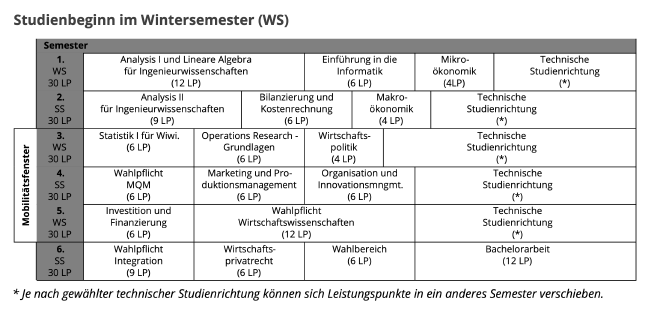
This is how the uni recommends you take the modules. Of course you can do everything however you want. I recommend doing your first semester exactly according to this plan, since all these subjects are the most basic ones and later modules build on them. I’d do Analysis 2 and statistics in the second semester, and the rest is up to you.
And now let’s look at the modules. Sadly I can’t describe every module in as much detail as Denis did, but I’ll try to get the gist across.
Difficulty levels are: easy, gotta put in the work, fucking brutal.
AnaLina (12 LP) and Ana2 (9 LP) #
Math is a sacred subject. I recommend studying it thoroughly, since all the math that comes later builds on this. You get to choose between Winkert and Penn-Karras. And everyone says they’re both great. Go to both lectures and pick whoever you like better. I went to Penn-Karras, she’s a really sweet grandma and explains things really well. Only her handwriting is tiny, otherwise everything’s great.
The subject itself is pretty hard and takes a lot of time. Three lectures, an Übung (exercise class), a Tutorium (tutorial) and mandatory homework (otherwise they won’t let you take the exam) in AnaLina. Ana2 is a bit easier: two lectures and a Tutorium.
Difficulty: fucking brutal
Einführung in die Informatik (6 LP) #
At the start they show you how a compooter works, then you’ll be programming. Depending on your specialization you pick a programming language (Java or C). Mostly they teach basic algorithms like searching or sorting. Pretty interesting module.
Difficulty: between gotta put in the work and fucking brutal
Mikroökonomie (4 LP) #
The math is super easy. Even a high schooler could handle it - find the derivative and that’s it. Your prof is Ivanova-Stenzel and she has a terrible accent. So you probably won’t understand much in the lecture. Try your luck in the Tutorien. The module covers the most boring basic topics in economics.
Difficulty: gotta put in the work
Makroökonomie (4 LP) #
You can only take it after microeconomics. The topics are similar, just now at the national level. Same math, but more graphs
Difficulty: gotta put in the work
Wirtschaftspolitik (4 LP) #
Also only after microeconomics. Even more boring theory. They tell you about different schools of economic thought.
Difficulty: gotta put in the work
Statistik I (6 LP) #
Great subject, teaches you basic skills for working with data. Videos with visualizations will help a lot!
Difficulty: fucking brutal
Bilanzierung und Kostenrechnung (6 LP) #
Basic accounting. Pretty hard to get into at first. But once you’re solving problems, you’ll get it all intuitively, no problem!
Difficulty: between easy and gotta put in the work
Operations Research (6 LP) #
We solve problems using algorithms. If you study hard in the Tutorien, you don’t even need to go to the lecture.
Difficulty: between easy and gotta put in the work
Marketing und Produktionsmanagement (6 LP) #
We cram the marketing slides, and for the Produktion part we solve problems (very similar to Operations Research).
Difficulty: between easy and gotta put in the work
Organisation- und Innovationsmanagement (6 LP) #
We cram all the slides for the exam. Pretty interesting module. They tell you which organizational style is optimal for which goals and that you always have to be innovative 💡
Difficulty: easy
Wirtschaftsprivatrecht (6 LP) #
Really interesting subject, they teach you the basics of German law. The Tutorien are great, the prof is really nice (but loves to talk a lot). Usually people either pass the exam with a 1.0 or fail. Anything in between is rare…
Difficulty: fucking brutal
Investition und Finanzierung (6 LP) #
This is where you dive into the world of finance. Passing the exam doesn’t guarantee you’ll get rich, but you’ll be able to understand what the financial news is saying and pretend to be smart.
Difficulty: between gotta put in the work and fucking brutal
Bachelor’s thesis (12 LP) #
Depending on the supervisor and the topic, this can be pure hell or a fun project for you. Start looking for a cool supervisor a semester before you want to write your thesis. Ideally pick the topic yourself, something you’re really interested in, otherwise writing the thesis will be a real ordeal for you.
The descriptions and difficulty levels above are a subjective assessment.