Computer Science (Informatik) B.Sc. at TU Berlin: Honest Student Guide
Table of Contents
Important side note. I’m “lucky” and started studying right in the middle of COVID, in WiSe 20/21 (winter semester 2020/21). So I did my first two semesters fully online, the third one half in person, and for all the rest I actually went to uni. This matters because the format of a module determines a lot, but overall everything I write here is still relevant.
Let me start with some general tips, in order of decreasing importance:
- Look for classmates who actually know their stuff right away and make friends with them. It’s hard, but doable. The easiest way is in the Tutorien (tutorials): watch who’s active and casually get to know them. Or/and Discord: this one and this one. Not so they do stuff for you, but so you can constantly meet up and study together. The earlier you start doing this, the higher your chances of actually finishing. Going solo is hard, because there’s group homework all the time anyway.
- Take your exams on the first Termin (exam date). This matters.
- The best exam prep is old Klausuren (exams) from previous years.
First look #
There’s this thing called the study plan. It’s put together pretty well, so following it seems logical to me. There’s a belief that the plan was thrown together just for laughs, because 6 semesters is “the baseline”, while on average people finish in 12 semesters anyway (real stats). But don’t panic! Word is that if you do everything smart, 6 semesters isn’t a fairy tale. If you haven’t read the general TU guide yet, this way. You can find info on each individual module on Moses or in the Telegram bot (temporarily down, I’ll get it back up soon).
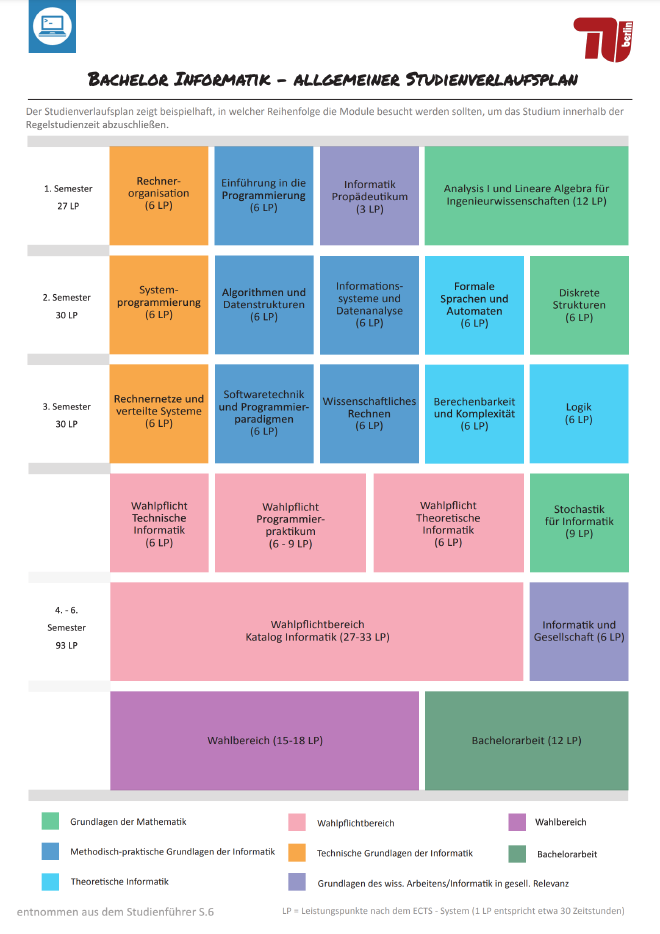
Next, semester by semester. The main info on each semester and subject, and how much time each specific module took me personally in total.
Semester 1 #
The first semester has only 4 subjects. The semester is relatively chill.
InfoProp: Informatik Propädeutikum #
Took 13.5 hours. Super basic intro to computer science: history, graphs, Turing machines and so on. The time spent says it all: zero effort and still a 1.0. The exam was purely about whether you’d memorized the theory, based on the optional homework, so better work through all of it before the exam.
ROrg: Rechnerorganisation #
Took 75 hours. A module about microprocessor architecture and assembly. Lectures: in my semester we had recorded videos and they were as dull as it gets. Felt like the prof was just reading the textbook over the slides, that’s it. IMHO, a waste of time. Easier to look at the slides and go to the Tutorien. In this module I often had the feeling that I understood absolutely nothing, but in the end you somehow figure it out.
In 2019 the grade consisted of three things: 20% multiple choice, 20% assembly homework (we had MIPS) and 60% exam. The first test is almost at the very beginning of the semester, so there’s no time to warm up, you need to study seriously right away so you don’t lose points, and then the test won’t be hard. Same with the homework, start right away, because it’s big: we had to code something like a Bloom filter. I can say for sure: if you did and understood all the Übungsblätter (exercise sheets), that should be more than enough for the homework. It helps a lot to first write the code in C, which by homework time you’ve already learned to write in IntroProg, and then everything gets easier. The exam is a normal one, covering all the material from the semester.
IntroProg: Einführung in die Programmierung #
Took 78 hours. Intro to programming in C. Some people think it’s sadism, an intro and in C on top of that, but I think it’s the right call.
The first two weeks are a crash course in C, then it’s pure algos and sorting, then semi-formal memory and runtime analysis gets added. The lectures are a nightmare - I literally fell asleep in every single one. The professor overcomplicates everything and explains badly, so personally I basically didn’t watch the lectures (ironic, since this prof later ended up being the head of the place I worked at, ha-ha). If the Tutorien and the lectures swapped places, things would be way clearer. The homework is super important: you’re allowed to fail only one, otherwise no admission to the exam and you automatically have to retake. Lots of people didn’t know that and it hurt. The homework varies in difficulty, but most of the time you can (and should) go to the Sprechstunde (office hours), they’ll definitely help you there (some people literally got code snippets thrown at them openly (we condemn this)). You see the homework test results right away, so no need to worry whether you passed or not. Green checkmark = passed. The exam in my year was the same nightmare. First experience with COVID and online, they made a completely insane exam and after they looked at the stats they had to adjust the Notenschlüssel (grading scale) to fix their mistake. But I remember back then I looked at the exams from the Präsenz (in-person) days and they were super easy, so it should be all good.
AnaLina: Analysis I und Lineare Algebra #
Took 119 hours. The module name says it all - math. There were two profs, Winkert was great, I watched all his lectures. There’s a requirement for exam admission, the homework is done in groups of 3 - overall nothing hard, but time-consuming. If you don’t meet the requirement you’re not admitted to the exam, so do all the homework. Plus it’s great prep for the exam.
Three lectures a week, because the module is 12 LP (Leistungspunkte, i.e. ECTS credits). Their difficulty ramps up pretty fast and by lecture 48 there’s a chance it’ll be hard to follow. But that’s no big deal: lots of people barely watched the lectures at all and still passed fine. But I watched them, it was useful. Better do all the exercises: the homework (that goes without saying) and the exercises for the Großübung (big plenary exercise session).
Semester 2 #
AlgoDat: Algorithmen und Datenstrukturen #
Took 109 hours. Pretty much the highlight of the semester. I had Brock, he’s very funny and a total drama queen, every semester there’s some plagiarism saga. The module name says it all, it’s done in Java, 11 homework assignments in total. They’re painful. In hindsight, sure, you can’t say there’s anything special about them, but in your second semester you’re pretty fucking overwhelmed and they eat a ton of time. The other thing is that at some point tests for the homework show up on the server so you can check your solution, but they become available less and less often, down to one run per week. So better start right after an assignment is published so you get to test a bit more toward the end. The upside is the suffering pays off and 50 percent of the grade is exactly this homework. It’s also a good course for learning to dig into things in more detail and without rushing: you grab a sheet of paper and a pen and sit there simulating runs. Will come in very handy later.
The exam is reasonable, nothing out of the ordinary.
ISDA: Informationssysteme und Datenanalyse #
Took 30 hours. Super easy module about databases, basic SQL and all that. The lectures from Borusan back then were hard for me to watch, and there wasn’t much point anyway. The exam used to consist of a midterm, homework and a final exam. The homework is auto-graded, so you can easily max it out (technically you could even hardcode it, but better actually get the basics down), everything else is just straight from the lectures and Tutorien. 30 hours for the whole semester is plenty for a 1.0.
DS: Diskrete Strukturen #
Took 57 hours. As far as I remember, it’s pain. Depends on the prof giving the lectures, I think it’s Kreutzer now, who’s super cool himself but explains everything in a very complicated way. The module is dangerous and very easy to fail.
The grade is made up of a midterm, a big homework and a final exam. The midterm is the easiest of all, so you can’t afford to lose precious points there. For the homework you need to find the most hardcore teammates you possibly can, so you suffer a bit less. The homework also has to be done in LaTeX, so it’s good to have at least a minimal idea of how to TeX beforehand, otherwise it takes a lot more time.
ForSa: Formale Sprachen und Automaten: #
Took 69 hours. First, the module is run by Nestmann, who really cares and tries to integrate every best practice possible. Second, it’s theoretical CS, so sometimes that doesn’t help. At first the subject can be confusing, but the main thing is to regularly do all the Tutorien, start the homework early (it also has to be TeXed), and not lose heart. In my year there was one big homework, then I think they made it two small ones, but the gist is the same. Now I think they’re also group work, up to 2 people.
The exam, as far as I remember, was very doable after all the Tutorien and Übungen (exercise sessions).
Daniil, WiSe 21/22: Chill module, the principle is that you don’t always need to get into the material 100%, the main thing is to understand the point of the exercises they give in the Tutorien etc., since the module itself is pretty well structured, you can get through everything fine and prepare for the tests. About the lecture itself, I only watched the videos, there was supposedly also a Modulkonferenz with Kahoot with the professor, I didn’t go, but people say it’s a really useful thing, the Kahoot format actually partly helped you understand things even before the Tutorium. The first test is super easy, the first homework too, basically just copying solutions from the Tutorien and the lecture I think, you just swap the relevant stuff for what’s in the task. The main thing is to keep all the formalities, they pay a lot of attention to those. The second homework I remember was harder, and without a good group it’s tough to do, even if you know your stuff yourself etc. The second test is also easy, there are tons of tests from previous years posted in the course itself, so there’s mega enough material to prepare. And you can prepare properly with it to write the Klausur at 80%+. Another tip: find Michelle’s Tutorien in the 2022 course, there are great recordings of them, you can figure out a lot from those too. Also on nlogspace there are relevant videos on the topics.
SysProg: Systemprogrammierung #
Took 62 hours. Alright, they taught us C in the first semester, somehow, now it’s time to arm ourselves with it and go into battle. The module is about operating systems, processes and all that jazz. In my semester there were four homework assignments, two written ones worth few points, two programming ones worth a lot of points. I coded the first one right up against the deadline, but got away with it. So I got the impression the second one would be the same, but it turned out to be way more of a mess, so that’s where I got caught out, so be careful. The first assignments are also group work, though there’s definitely not enough work in them for 4 people.
The exam seemed easy while I was writing it, but when the results came in it turned out there were plenty of subtleties too, so be extremely careful there as well.
By this point in your studies, new insights start showing up:
- Look for good tutors right away, definitely WiMis (wissenschaftliche Mitarbeiter, i.e. research associates) if there are any. Go to every Tutorium, keep showing your face and get to know them.
- Same goes for the prof. If there are any Q&As, try to take part very actively, just so the prof remembers you. It’ll definitely pay off when you need to write your thesis and figure out what the hell to do with your life.
- After the first semester you can totally get a job as a Werkstudent (working student), but you’ll have to keep applying for a long time if you don’t have any projects of your own. But something will definitely turn up. If the job isn’t some slacker home-office gig, it’ll be hard to combine with 30LP. But nothing is impossible!
- To make point three easier, do a pet project over the semester break and push it to GitHub, and properly polish how it’s presented.
Semester 3 #
The overall impression of this semester is that it’s much more balanced compared to the others, there are no subjects where you can get away with doing practically nothing.
RN: Rechnernetze und verteilte Systeme #
Took 56 hours. Module about networks, protocols and all that stuff. The module used to be considered one of the hardest because of the homework — back then it was the requirement for exam admission and you couldn’t skip it. In my semester they decided to experiment and changed the format, now the homework was 10% of the grade. Naturally, nobody did it. The points-to-effort ratio was totally not worth it, because to do all the homework back then you’d confidently have to multiply the time spent on the module by three. Now things have changed a bit: the homework is worth 30%, which is already significant, and they reworked it, it’s not that brutal anymore. So it should be doable. The exam is normal, no surprises.
BeKo: Berechenbarkeit und Komplexität #
Took 64 hours. Computability, complexity, reductions, and so on down the list. Overall a great and interesting module, but in places it can seem not the most intuitive or trivial. Don’t know what the lectures are like now, but if they’re shit, you can always enroll in the 21/22 course and watch the videos, they’re excellent. As always, I highly recommend going to the Tutorien, ideally with a WiMi. The exam is tough with all sorts of proofs, same as the homework, so budget your energy and nerves.
SWTPP: Softwaretechnik und Programmierparadigmen #
Took 64 hours. Pretty dull module that SUPPOSEDLY is about how to write code in general, but actually isn’t about that at all. Tedious UML diagram stuff, unfortunately not much focus on paradigms as such. Overall the exam is fine if you work through all the lectures, the homework is pretty big.
In my semester we had to write the logic for Chinese chess and code a bot in Haskell that would play against you. We didn’t have time for the Haskell part at all, which is a shame, people held a bot tournament afterwards.
WiRe: Wissenschaftliches Rechnen #
Took 75 hours. Kind of a continuation of LinAlg and Analysis, except it’s also tied to the real world. The Python homework is very interesting, but I think it takes up most of the total time, though it counts straight into the grade. In my semester there was one insane exam online, and a super easy exam in real life, so I think it should all be reasonable now too. The lectures are chaotic, I didn’t watch them. Honestly, the genius move is to do AnaLina in Early Bird before your studies even start and WiRe in the first semester, too bad I didn’t know about that option :(
Logik #
Took 87 hours. People curse and hate it, but overall it’s an okay module. Go to all the Tutorien, again only with WiMis, to every Großübung, and everything will be tip-top (meaning: passed). The lectures are hard to digest, as far as I remember, but my memory might be off, it was a long time ago. Probably the most unpleasant part — two big and hard homework assignments, here the only thing you can do is find good teammates.
After this semester the Spaß (fun) starts, but only halfway in: you get to choose, but not from a huge selection. But in the fifth semester…
Semesters 4 - 6 #
Halfway point reached, the more fun half of your studies is what’s left. There are still a couple of mandatory subjects, like Stochastik or Informatik und Gesellschaft, but apart from those the rest of the subjects are chosen individually. There are several categories you need to fill, because that’s what it says in the StuPo (study and exam regulations). First about the remaining mandatory modules, and then about each category in more detail.
IG: Informatik und Gesellschaft #
Don’t know exactly how much time it took, but not that much. Overall the idea of the module isn’t bad: a kind of intro to scientific writing, how to cite properly and stuff like that. In my opinion, a whole module for that is overkill. The structure of the module keeps changing a lot. In my year we had to make a scientific poster in groups of 4 on a topic we chose (it was right in the LLM boom back then, so that’s what we did) and present it, write a very long essay on that topic, and at the end there was also an exam.
Stochastik #
Took 78 hours. I really dug it, a cool module from the math people. With the professor giving the lectures it’s luck of the draw, but overall you don’t need them: grab the book, work through it, go to all the Tutorien, do all the homework in pairs, show up to the exam, write a 1.0, profit. The exam is definitely not easy and you can tell from the hours that the module is definitely not a freebie, but I just really enjoyed it. I’ve heard other opinions, how people don’t vibe with it and suffer a lot, so it’s individual. Basically it’s a pretty solid intro to statistics and probability theory.
Wahlpflichtbereich (45-48 LP) #
Technische Informatik (6LP) #
The classic setup here: three subjects to choose from, you need to do one:
- Verteilte Systeme: Took 50 hours. Not to be confused with Rechnernetze, which keeps getting renamed to Rechnernetze und verteilte Systeme and then back to just Rechnernetze. The module is run by Kao, the homework (Sockets, Java NIO, Pub/Sub, Apache Camel) is done in groups of 4 and takes up most of the time in the course. The exam is reasonable.
- Digitale Systeme: Didn’t take it, but it’s considered a super chill course with high-school CS material about Gatter (logic gates) and logic circuits. If you’re short on time and want a 1.0, go for it.
- Kommunikationsnetze: Didn’t take it and haven’t heard anything about it.
Theoretische Informatik (6LP) #
Also three subjects to choose from. In my opinion all of them are cool and interesting:
-
Algorithmentheorie (listed in the StuPo as Grundlagen der Algorithmik): Took 87 hours. Super cool module for training your brain and algorithmic thinking. Hard homework, medium-hard exam, great lectures. Basically it’s theoretical prep for LeetCode, just way more hardcore: Network Flow, DP, ILP and so on. Highly recommend, the time you put in is worth it, but it won’t be easy.
-
Logische Methoden der Informatik: Took 74 hours. Very niche module. If you really dug Logik, then you have to take it: here they finally show you what the deal with logic is, what cool stuff you can do with it, and generally crack open the door to the cool world of Theoretical Computer Science. Be ready to understand practically nothing in the lectures, but still go from time to time. The Großübung is better, the Tutorien are way better. Personally, how it went for me is that toward the end of the semester you sit down and read the Skript (lecture notes) very slowly and very thoughtfully and figure it all out from scratch. That takes two or three weeks and a good study group, alone it’s rough. The exam itself is super predictable and easy, you practically know in advance everything they’ll ask you (doesn’t make it much easier though). Kreutzer is great and exams with him are a vibe.
-
Reaktive Systeme: Didn’t take it, but heard it’s a cool module. Run by Nestmann, who’s known for having cool modules and lectures, he really puts in the effort, big plus for that. At the end there’s an oral exam I think, and I think it’s not exactly easy.
An attentive reader may notice at this point that you need to do one module in this category, and I did two, just because the modules seemed interesting. But there’s an important disclaimer about that:
Programmierpraktikum (6-9LP) #
First of all, this isn’t a real internship / work placement, like many people think, although that kind of thing exists in, say, Maschinenbau (mechanical engineering). It’s just a module at uni that falls into this category, and you also have to somehow manage to get a spot in one.
Second, it’s a circus. Always has been and still is. Historically, there have been way, way fewer Praktikum spots than people who need to do one (after all, it’s mandatory to get your degree). Spots used to be handed out based on which semester you were in, and in the end they were taken by people in semesters 8-12. Then they set up a scheme where you have to state whether you applied in previous semesters or not, and if yes, your chances are higher. So:
Every semester the Praktika are different, look for what interests you, but don’t really count on getting into exactly that one. I did:
- Skalierbare Systeme: Took like 20 hours. Basically the module just introduces you to modern web development, if you had no experience before that, it’s fine, if you did, it’s a super easy pass. You have to build a full-stack app, deploy it and then tell everyone in a presentation how you all diligently and intensely moved tickets around the Jira board. It’d be fun if you could choose the project completely yourself, but in this iteration it had to be something connected to CO2 emissions, because the guy organizing the module was doing his research on that topic. Makes sense, but not fun.
Seminar (3LP) #
Important point. It’s not in the plan, but the seminar is mandatory for everyone according to the StuPo, meaning you can’t skip it.
Same scheme as with the Praktikum. Applications through a special Metaseite on ISIS. But there’s a life hack: many seminars aren’t published on the Metaseite, the Fachgebiete (chairs/research groups) just run them quietly. For example, the seminar for the Kognitive Algorithmen module. So I strongly recommend digging through the Fachgebiete’s websites and looking for a seminar there to skip all the queues.
Usually all seminars are easy and 3LP, you need to do something like mini research / a presentation on some topic. I did:
- Angewandte Logiken: Took like 5 hours. Had to do a presentation and a paper on some topic, I talked about Prolog (ha-ha). Ours was online, for a couple of days you all meet up for a few hours and present whatever interesting stuff you dug up.
Katalog Informatik (27-30 LP) #
Next you go to Moses, turn on the catalog filter and look at what interests you. Ideally, roughly figure out what you want to do after the 3rd semester, because some modules are only offered in the winter semester and some only in the summer, meaning you need to plan everything smartly. Here are the modules I did:
-
Kognitive Algorithmen: took 41 hours. Good intro to ML. I’d recommend taking it before ML1/2 or MI1/2. In my opinion the module is well balanced: enough math, homework for a bonus of 10% of the final grade, where you have to code the concepts you covered like the perceptron or SVM and do theory quizzes. The exam isn’t easy, but super reasonable and strictly on the material covered.
-
Computer Graphics 1: took 97 hours. Module about graphics, shaders, rendering. Basically they walk you through the whole pipeline from start to finish. Personally I didn’t vibe with the lectures, but I loved the Q&A sessions, because Professor Alexa is a really cool guy and knows his stuff. The homework is debatable: some of it is only loosely connected to the material covered and takes a really long time. As far as I remember, all the homework is 40% of the grade, the other 60% is two exams. The exams are also reasonable and pretty much based on the lectures, but you need to prepare decently to do well. The exam isn’t the “memorize everything” kind, you actually have to think, and that’s cool.
-
Algorithm Engineering: took 83 hours. Oh man, how many nerves this module cost me. The only module in my whole studies where I really didn’t sleep all night and then rode half-dead to uni for presentations at 8 am in the nasty Berlin winter. The module is cool, the concept is super cool. Work in teams of 3. For the whole semester you have one single algorithmic problem, in mine it was Vertex Cover. Every two or three weeks they present new concepts and tricks for solving Vertex Cover optimally.
All this time, in parallel, you and your group write a Solver that’s supposed to solve Vertex Cover. They give you a uni server where you can benchmark your solver and see how far you’ve gotten. Very fun and very interesting. If you’re unlucky with your team, it’s a real shitshow, solo it’s very hard to handle the amount of stuff you need to code, especially if you don’t have much experience with algorithmic programming. In my semester you had to submit the solver every three weeks, plus a handout describing what we’d done there, and prepare a presentation and give it.
As far as I know, they’ve now turned the module into a Praktikum and dropped the presentations and handouts. That’s sad, because those are really cool and important skills for research, but at the same time they managed to scale the module from 15 to 120 people, so I can understand it. I recommend it to everyone, but be ready to work.
-
Distributed System Prototyping: not sure exactly, but took a decent amount of time. This module also cost me a ton of nerves. The concept is cool: every semester there are several projects, most often even with real companies. Each project is supervised by a different Fachgebiet, so it’s luck of the draw. I got really lucky with my supervisors, very cool and nice guys, Karl Wolf and Sebastian Werner. But the team for the project… A disaster. But unfortunately nobody’s safe from that, and it’s a really great opportunity to try on the role of tech lead and learn to resolve conflicts, so a great experience. But with the project topic it’s luck of the draw: our team built a Federated Marketplace, something like Mastodon for the world of marketplaces, while other groups had, in my opinion, the most boring projects. So choose wisely. Basically you spend the whole semester working on your project, and how cool it turns out and what you build depends only on you.
-
Multimodal Interaction: not sure exactly, but very little time. Module about human-computer interaction, personally the topic isn’t very interesting to me, the module itself is super easy. Two exams where you have to memorize the slides by heart, a few easy homework assignments and a game you can code in about a week.
Wahlbereich (15-18 LP) #
You can count any modules here, even from other unis if you really want. This wasn’t very relevant for me, because I wanted to do computer science modules, which are all in the catalog anyway, so basically I just counted some of them toward this category. But if you really want to do philosophy and the history of ancient Greece, go for it, you can fit a whole three modules here.
Bachelorarbeit (12 LP) #
This is possibly the trickiest part of your studies. If you’re unlucky, you’ll suffer the whole semester, maybe even two. I suffered. If you’re lucky, you’ll be vibing and enjoying your last months at uni. I’ll write a whole separate guide about the Bachelorarbeit (bachelor’s thesis) and how to organize everything smartly, but I’ll write a couple of points here:
-
Go to the Infotag Abschlussarbeit (thesis info day). Overall they do a good job there of telling you what the process looks like and all the nuances.
-
Start thinking about your thesis as early as the 4th semester. You need to reflect on what you liked most up to that point in your studies, dig deeper into it, and if you’re convinced that’s the one, write your thesis on that topic.
-
Theses can vary. There are super easy topics and Fachgebiete where you need to write a little website and that’s it, you’re a Bachelor of Science! There’s hardcore, where you need to put in a lot of time, effort and brains. I recommend the second, because professionally it’ll pay off big time.
Conclusion #
That’s it, your studies are over. If you’re lucky, you made it through in three years and the time flew by, that’s how it was for me personally. Enjoy your studies, meet people, and ask yourself more often whether you like what you’re doing right now. Drop by our Telegram chat (Russian-speaking), or if you have questions, message me on Telegram.